
By Sukhjinder Singh February 17, 2026 0 Comments

Annual Market Salary Rate (AMSR) 2026

What is the Annual Market Salary Rate (AMSR)?

The Annual Market Salary Rate (AMSR) is the Australian Government’s way of ensuring overseas workers are paid a fair, competitive wage. Simply put, it is the exact market rate that an Australian citizen or permanent resident would earn for doing the same job in the same location.

Purpose of the AMSR

The Australian Government enforces the AMSR rule for two reasons:

1. Protecting Overseas Workers from Exploitation

The AMSR ensures that a business isn’t bringing in a skilled migrant worker and paying them unfairly. By calculating the AMSR, the government verifies that the sponsored worker will be paid the exact same fair-market wage that a local Australian would earn for doing the same job, in the same city, with the same level of experience.

2. Protecting the Local Australian Labour Market

The Australian Government enforces the AMSR to prevent businesses from using the visa system to undercut local wages with cheaper overseas labour.
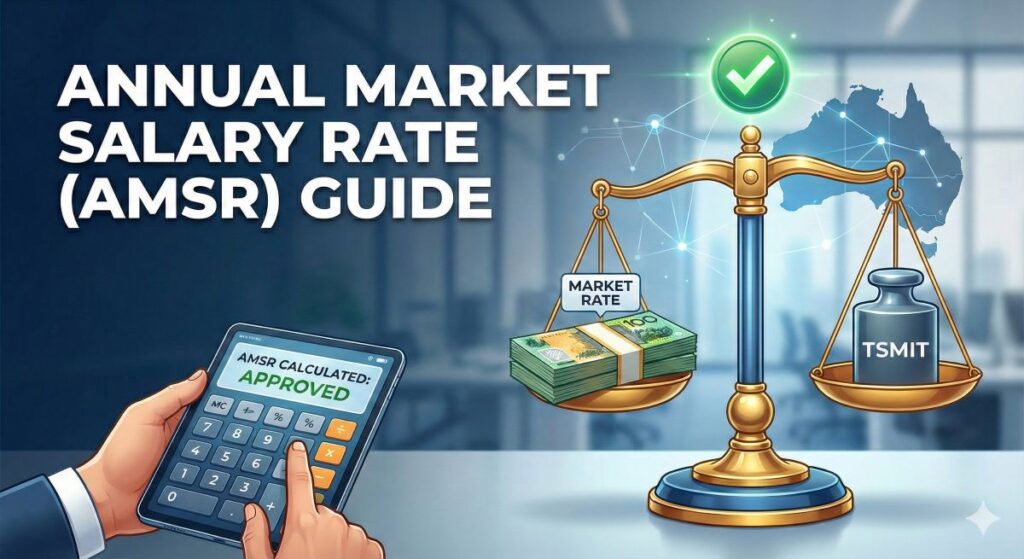
photo showing balance of TSMIT and Annual market Salary rate for 482 nomination

Which Visas Require the AMSR?

You must prove the AMSR when lodging an employer nomination for the following visas:

How to Calculate the AMSR (Step-by-Step Methods)

How you prove the market rate to the government depends entirely on your current workforce and whether the job is governed by an industry award.

Method 1: You already employ an Australian worker doing the exact same job in the same location

  • If an Award applies: If your Australian worker’s pay is dictated by a formal industry award or enterprise agreement, the AMSR is simply the salary rate listed in that official document.
  • If NO Award applies: If no award covers the role, the AMSR is exactly what you are currently paying your Australian worker. You prove this by providing their current employment contract and recent payslips.

Method 2: You DO NOT have an Australian worker doing the exact same job

  • If an Award applies: Even without a local worker, if the vacant position is covered by a formal industry award or enterprise agreement, the AMSR is the standard rate listed in that document.
  • If NO Award applies: If the role is not covered by an award, you must figure out what an Australian worker would be paid. You cannot just guess—you must prove this by gathering external market evidence, such as recent job advertisements, independent salary surveys, or official government data.

The Difference Between AMSR and TSMIT

While both rules are designed to protect workers’ wages, they measure two completely different things:

  • TSMIT (Temporary Skilled Migration Income Threshold): This is the government-mandated safety net. No matter what the job is, the Australian Government says you cannot legally sponsor an overseas worker for less than this absolute minimum baseline (currently $76,515) unless you have TSMIT concession under labour agreement.
  • AMSR (Annual Market Salary Rate): This is the real-world market rate. It is the specific salary an Australian citizen would be paid to do the exact same job, in the exact same city.+1

The Golden Rule: You must always pay the worker whichever number is higher.

  • If the TSMIT is $76,515, but the AMSR (market rate) for a specialized IT Manager is $95,000, you must pay $95,000.
  • If the AMSR for a junior role is $75,000, which is below the TSMIT, the employer must pay the higher threshold which is $76,515.

Common AMSR Mistakes to Avoid

  • Ignoring Location: A standard salary in Sydney CBD is very different from a salary in regional Western Australia. Your evidence (like job ads) must match the location where the employee will actually work.
  • Including Bonuses: The AMSR and the TSMIT only look at guaranteed base salary. You cannot include discretionary bonuses, overtime, or non-monetary perks (like a company car or accommodation) to meet the threshold.
  • Using Global Data: The Department only cares about the Australian labour market. Do not use international salary data to justify the pay rate.

FAQs

What is the minimum salary for 482 visa?

As of the latest Australian Government updates, the absolute minimum base salary for a Subclass 482 visa depends on the specific pathway you are using:

1. Core Skills Stream: The legal baseline—known as the TSMIT (Temporary Skilled Migration Income Threshold)—is $76,515 plus superannuation. You cannot sponsor an overseas worker for a standard role if the salary falls below this amount.

2. Specialist Skills Stream: If you are using the premium, fast-tracked pathway for highly skilled professionals, the absolute minimum salary requirement jumps to $141,210 plus superannuation..

Is there any exemption from the Annual Market Salary Rate (AMSR) requirement?

Yes, there is a limited exemption. If the nominated annual earnings are at least AUD $250,000, the position is exempt from the Annual Market Salary Rate (AMSR) requirement.

Can I include bonuses, overtime, or a company car to reach the AMSR threshold?

No. Both the AMSR and the TSMIT are calculated using only guaranteed base salary. You cannot include discretionary performance bonuses, expected overtime, superannuation, or non-monetary perks (like free accommodation or a company car) to artificially inflate the salary and meet the visa requirements.

Can I use global salary data to prove the AMSR?

No. The Department of Home Affairs strictly requires Australian data. You cannot use international salary surveys or global pay scales to justify your wage offer. You must use local data, such as Australian job advertisements, Fair Work awards, or Australian remuneration surveys (like Hays or JobOutlook).

What happens if the AMSR is higher than the TSMIT?

Under Australian immigration law, the sponsoring employer must always pay whichever amount is higher.
The TSMIT (currently $76,515) acts as an absolute legal safety net. However, if the actual market rate (AMSR) for your specific job is higher than that baseline, the employer is legally required to pay the higher AMSR.

PREV POST Subclass 482 Nomination Process & Checklist 2026
NEXT POST Standard Business Sponsorship Fee, Checklist and Requirements (SBS 2026)

5 Tips to Choose a Migration Agent

Download Guide