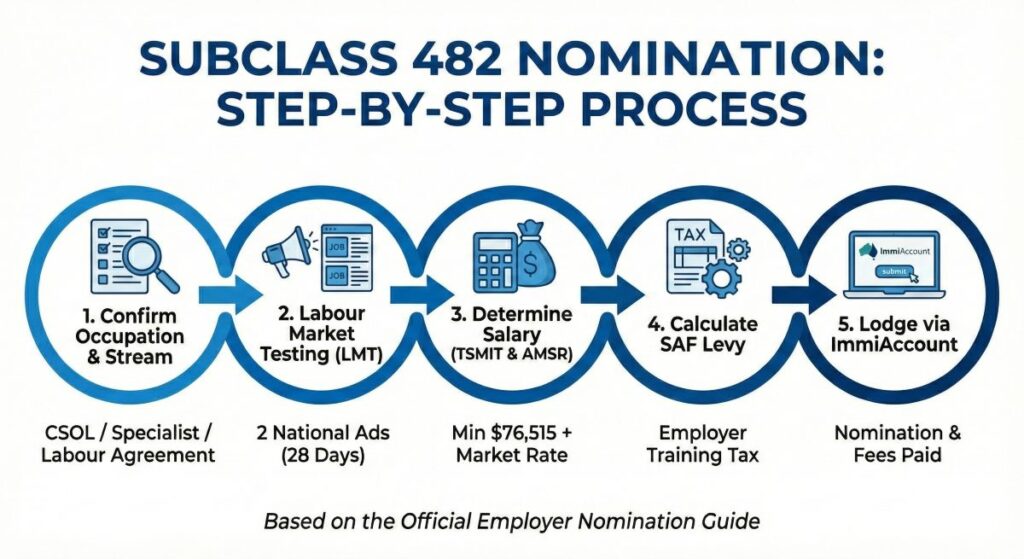
The 482 nomination process is simply the step where you, the employer, ask the Australian Government for permission to fill a specific job vacancy with an overseas worker. You are basically proving that your business has a genuine need for the role, the pay is fair, and you couldn’t find a local Australian to do the job.
The occupation must be listed on the relevant Skilled Occupation List. Depending on the role and the salary, the nomination will fall under one of three streams:
Core Skills Stream: For most occupations listed on the Core Skills Occupation List (CSOL).
Specialist Skills Stream: A fast-tracked option for highly skilled roles offering a salary at least equal to Specialist Skills Income Threshold.
Essential Skills (Labour Agreement) Stream: For employers who have a specific, negotiated agreement with the Australian Government.
Step 2: Conduct Labour Market Testing (LMT)
You cannot simply offer a job to an overseas worker. You must legally prove that you tried to hire an Australian citizen or permanent resident first. This is called Labour Market Testing (LMT), and it requires you to advertise the position in Australia following very strict government rules for at least 28 consecutive days before you lodge the nomination.
Step 3: Determine the Salary (AMSR and TSMIT)
To protect migrant workers from exploitation and prevent the undercutting of local wages, the Department of Home Affairs requires you to meet two strict salary rules:
Temporary Skilled Migration Income Threshold (TSMIT): TSMIT is the absolute minimum base salary you can offer a sponsored worker. It is $76,515 for Core Skills Stream and $141,210 for Specialist Skills Stream.
Annual Market Salary Rate (AMSR): You must prove that the salary you are offering the overseas worker is exactly what you would pay an equivalent Australian worker in the same location.
Step 4: Calculate and Pay the SAF Levy
When you lodge the nomination, you are required to pay the Skilling Australians Fund (SAF) Levy. This is a mandatory tax used to fund training for Australian apprentices.
Turnover under $10 million:$1200 per year of the visa duration.
Turnover over $10 million:$1800 per year of the visa duration.
Step 5: Pay Nomination Fees & Lodge the Nomination
Once your LMT is complete and your documents are gathered, you will submit the nomination application through your ImmiAccount, linking it to your Standard Business Sponsorship. At this stage, the employer is legally required to pay the government charges upfront. This includes a base Nomination Application Fee$330, plus the mandatory Skilling Australians Fund (SAF) Levy.
The 482 Nomination Document Checklist
To ensure a smooth approval, employers must provide a robust portfolio of evidence. Use this checklist before lodging your application:
1. Business Registration & Lawful Operation
The Department of Home Affairs must verify that your business is legally established and currently active in Australia.
ABN or ACN Certificate: A copy of your official Australian Business Number or Australian Company Number registration.
Current Company Extract: An ASIC company extract showing the current business owner and director details.
Trust Deed (If applicable): If your business operates under a trust structure, you must provide the Trust Deed (or the schedule and execution pages) showing the Trustee and Beneficiaries.
Franchise Agreement (If applicable): A signed copy of the franchise agreement if you operate under a franchise model.
Premises Evidence: A signed commercial lease agreement or proof of property ownership for your business location, alongside photos of the business premises (front entrance, signage, and interior).
2. Financial Viability Documents
You must prove that your business is financially healthy enough to afford the sponsored worker’s salary for the entire duration of their visa.
Accountant’s Letter of Support: A formal letter from a registered CPA or CA confirming that the business has been actively operating and is financially viable enough to meet its wage obligations.
Financial Statements: Your most recent Profit & Loss Statement and Balance Sheet.
Tax Returns: The most recently lodged business tax return and Notice of Assessment.
BAS Statements: Business Activity Statements (BAS) for the last four quarters to show consistent cash flow.
Business Bank Statements: Recent bank statements showing active business transactions.
3. Proving the “Genuine Need”
The government wants to ensure you aren’t creating a “fake” role just to sponsor a visa. You must show exactly where this worker fits into your operations.
Detailed Organisational Chart: A visual chart showing all positions in your company. You must identify the names of current staff, their visa/residency status, and clearly highlight exactly where the new nominated position sits.
Workforce Summary: A breakdown of your total staff count, categorized by Full-time, Part-time, and Casual employees.
Evidence of Vacancy: Proof of why the role is empty. This could be a resignation letter from the previous employee, evidence of business expansion, or a new major client contract that requires extra staff.
Position Description: A detailed duty statement outlining the daily tasks and responsibilities of the role. These duties must strongly align with the official ANZSCO definition for the occupation.
4. Labour Market Testing (LMT) Evidence
This is the most critical step. You must legally prove you tried to hire an Australian citizen or permanent resident first.
Evidence of Advertising: Copies and screenshots of two (2) separate job advertisements placed on platforms with national reach (e.g., Workforce Australia, Seek, Indeed, LinkedIn etc).
Proof of Duration: Evidence that the ads were live for at least 28 consecutive days.
Proof of Timing: Evidence that the ads were run within the 4 months immediately prior to lodging the nomination.
Ad Content Proof: The ads must clearly show the job title, business name, and the salary range (if the salary is under $96,400).
Payment Receipts: Tax invoices proving you paid for the job advertisements.
5. Position, Salary, and Contract Documents
To protect migrant workers, you must prove you are paying the market rate and meeting the Temporary Skilled Migration Income Threshold (TSMIT), which is $76,515 as of July 2025.
The Employment Contract: A signed draft contract for the nominee. It must state the Annual Base Salary (excluding superannuation), outline standard work hours (usually 38 hours/week), and specify that employment formally commences upon visa grant.
AMSR Evidence (Equivalent Worker): If you already employ an Australian citizen in the exact same role, you must provide their employment contract and recent payslips to prove you are paying the overseas worker the same rate.
AMSR Evidence (No Equivalent Worker): If you do not have a local worker in the same role, you must provide market salary data, relevant industrial awards, or enterprise agreements to justify the salary you are offering.
Written Attestation: A signed declaration stating your commitment to employing local labour and ensuring non-discriminatory recruitment practices.
6. Nominee Details and SAF Levy Receipt
Finally, you must link the nomination to the specific overseas worker and pay the required government taxes.
Nominee Identification: A clear, colour copy of the primary applicant’s passport bio-page.
SAF Levy Receipt: Proof of payment for the Skilling Australians Fund (SAF) Levy. This is calculated based on your business turnover and the number of years the visa is valid for.
Common Reasons for Nomination Application Refusals
When a 482 nomination is refused, it is almost always due to one of these three avoidable mistakes:
1. Failing to meet LMT Requirements
LMT is incredibly rigid. If you advertise the role on Facebook instead of a national job board, or if you only run the ad for 27 days instead of 28, your nomination will be instantly refused. The ads must also include the job title, your business name, and the salary range (if the salary is under $96,400).
2. Failing the “Genuine Need” Test
The Department of Home Affairs is constantly on the lookout for businesses creating “fake” jobs just to get a visa for a friend or relative. Your documentation must paint a clear picture of why your business’s growth or current operations legitimately require this specific role to be filled immediately.
3. Ignoring Occupation Caveats
Certain occupations on the skilled lists have hidden “caveats.” For example, if you are nominating an Accountant or a Chef, there are strict rules regarding the type of establishment you operate (e.g., a Chef cannot be nominated for a fast-food or takeaway restaurant). Always check the caveats for your specific ANZSCO code before starting the process!
FAQs
How much does a 482 visa nomination cost?
The nomination application fee for lodging a 482 nomination is $330. However, the employer must also pay the Skilling Australians Fund (SAF) Levy at the exact same time. This levy costs $1,200 per year of the visa for small businesses, or $1,800 per year for businesses with a turnover above $10 million.
What happens if a 482 nomination is refused?
If a 482 nomination is refused, the associated visa application cannot be approved, and the applicant should withdraw it within 28 days to avoid a visa refusal. Financially, the employer will lose the $330 nomination fee and the SAF Levy, as these are rarely refunded. Moving forward, the employer has two options: appeal the decision to the Administrative Review Tribunal (ART), or correct the errors and pay to lodge a brand-new nomination.
How soon can a 482 visa worker apply for Permanent Residency (PR)?
Under the current rules, 482 visa holders (across all streams) can transition to permanent residency through the Subclass 186 Employer Nomination Scheme after just 2 years of working full-time for their sponsoring employer.