When applying for the Employer Nomination Scheme (Subclass 186) visa, depending on your occupation and the State or Territory where you will be working, you may also need to meet strict Subclass 186 visa licensing or registration requirements. Failing to understand these rules can lead to a costly visa refusal.
Here is a complete breakdown of when registration is mandatory, the difference between “holding” and being “eligible,” and how this impacts your visa application.
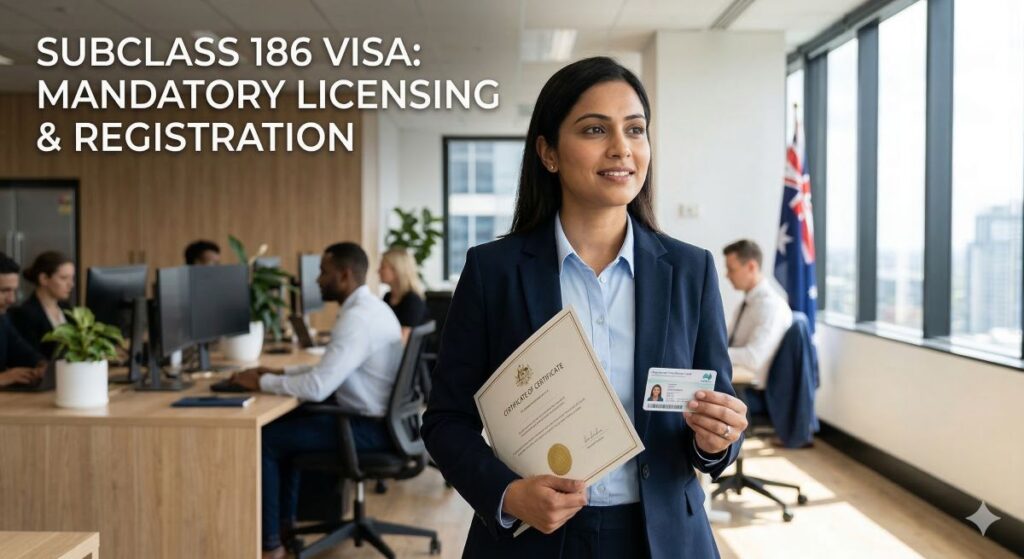
If your occupation requires mandatory registration, licensing, or professional membership in the State or Territory where you are nominated to work, you must either hold or be eligible to hold it at the exact time of application.
Evidence dated or approved after you lodge your visa application is only accepted if it clearly proves you met all the requirements to be eligible on the day you applied. You cannot lodge the visa first and figure out the licensing later.
The Department of Home Affairs has a very specific definition of “mandatory” for visa purposes:
Generally, your license or registration must allow you to perform the full range of tasks at the required skill level for your occupation.
In some jurisdictions, you do not need to physically hold the license at the time of application, but you must be legally eligible to hold it.
To prove eligibility, you must show you have completed all the required study or training curricula set by the relevant assessing authority, or have an officially recognized equivalent overseas qualification.
Example: Social Worker (ANZSCO 272511)
Social workers in Australia are not legally required to hold registration, but they must be eligible for full professional membership with the Australian Association of Social Workers (AASW). Since only the AASW can determine this, you must have a statement from them confirming your eligibility. If you apply for a 186 visa without being eligible for full AASW membership, you will fail to meet the criteria.
A common trap for applicants is confusing a Skills Assessment with Licensing/Registration. They are usually two completely separate requirements, and you generally need both.
There is only one major exception: When the skills assessing authority and the licensing authority are the exact same entity.
| Scenario | Rule | Example |
| Authorities are the SAME | Registration alone can act as evidence of your skills. No separate skills assessment is needed. | General Medical Practitioner: The Medical Board of Australia (via AHPRA) is the assessing authority and registering authority. Full AHPRA registration covers both requirements. |
| Authorities are DIFFERENT | You must provide BOTH a valid registration AND a separate positive skills assessment. | Registered Nurse: AHPRA handles registration, but ANMAC handles the skills assessment. You must provide evidence from both bodies. |
The short answer is No. If registration, licensing, or professional membership is mandatory for your occupation in your nominated State or Territory, the Department of Home Affairs cannot and will not waive this requirement under any circumstances.
Look up your nominated occupation in the ANZSCO (Australian and New Zealand Standard Classification of Occupations) directory.
The ANZSCO description will indicate whether licensing or registration may be required. You will find one of the three options mentioned below:
If the ANZSCO description clearly states that licensing, registration, or professional membership is required, then:
If the ANZSCO description uses wording such as “may be required”, then:
If the ANZSCO description does not mention licensing or registration at all, then: